Custom Search

Wednesday, August 27, 2008

Truths of Appreciation!!

My friend, Bob Danzig, has an amazing story. Simple words of appreciation and encouragement changed his life. Bob was in five foster homes during his youth, and said he spent his childhood trying to find someone to love and appreciate him.

When he was nine years old, he had a new social worker. He said after she had done all the paperwork to move him to yet another foster home, she sat him down, looked him directly in the eyes, and said, "Bobby, I want you to always remember these words: YOU ARE WORTHWHILE!"

Bob says that no one had ever said anything like that to him, and each time they met, she repeated those words. They became an affirmation of appreciation that he heard over and over again in his head.

Bob graduated at sixteen, not because he was smart, he says, but because he got mixed up in the system! He soon took a job at the Albany New York Times as a copy boy, and his very first boss was a woman named Margaret.

After he had worked there about six months, Margaret called him into her office one day and asked him to sit down. He thought for sure he was going to be fired! She looked him right in the eyes and said to him, "I have been the office manager for 15 years – I have been observing you – and I believe YOU ARE FULL OF PROMISE."

Those words, on that day, gave him permission to aspire.

Those two positive messages of appreciation played over and over again in his head and ultimately gave him the courage to be the very best he could be. Sixteen years later he became the Publisher of the Albany New York Times, and seven years after that, he became CEO of Hearst Newspapers, one of the largest newspaper companies in the world-and he credits it all to those simple words of appreciation and love.

What a wonderful example of how little gifts of appreciation can make such a difference in a life!

Zig Ziglar had this to say: "You never know when a moment and a few sincere words can have an impact on a life."
--Barbara Glanz

Friday, August 8, 2008

The Power of Words & Friends

There once was a little boy who had a bad temper. His father gave him a bag of nails and told him that every time he lost his temper, he must hammer a nail into the back of the fence. The first day the boy had driven 37 nails into the fence. Over the next few weeks, as he learned to control his anger, the number of nails hammered daily gradually dwindled down. He discovered it was easier to hold his temper than to drive those nails into the fence.
Finally the day came when the boy didn't lose his temper at all. He told his father about it and the father suggested that the boy now pull out one nail for each day that he was able to hold his temper. The days passed and the young boy was finally able to tell his father that all the nails were gone.
The father took his son by the hand and led him to the fence. He said, "You have done well, my son, but look at the holes in the fence. The fence will never be the same. When you say things in anger, they leave a scar just like this one. You can put a knife in a man and draw it out. It won't matter how many times you say I'm sorry, the wound is still there. A verbal wound is as bad as a physical one."
Friends are a very rare jewel, indeed. They make you smile and encourage you to succeed. They lend an ear, they share a word of praise, and they always want to open their hearts to us.
~~~~~~~~~~~~~~~~~~~~
"Friends are angels who lift us to our feet when our wings have trouble
remembering how to fly"-Anonymous

Wednesday, July 30, 2008

Baby Buddhas

I like to think that if the Buddha were alive today, he would hang out at the local playground. I could imagine him playing on the swings or goofing around the water fountain on a hot summer day. He would, I suspect, encounter several kindred spirits in the sandbox. The boy digging a hole and singing to himself. The two friends burying each other's feet. The mother nursing a baby.
I didn't start to picture the Buddha at the playground until I had a child of my own, and also became an elementary school teacher. I had thought a lot about the Buddhist principles of mindfulness and compassion, but it wasn't until I was living and working with small children that I truly began to try and put those principles into practice. Two questions kept occurring to me: How can the principles of mindfulness and compassion enrich our parenting? What can babies and young children teach their parents about mindfulness and compassion?
In his account of the Buddha's life, Old Path White Clouds, Thich Nhat Hanh describes a discussion about mindfulness that the Buddha has with a group of village children. To demonstrate the value of living in the present moment, the Buddha explains the difference between eating a tangerine with awareness and without awareness. With awareness, the sweet fragrance and flavor of the tangerine can be fully savored, but when eaten without awareness, the tangerine's smell and taste remain unnoticed.
This discussion occurs early in the Buddha's spiritual journey, just after he has discovered the path he will follow, but before he has set out to formally teach his wisdom to monks and other seekers. It is noteworthy and highly appropriate that children are the Buddha's first audience for an account of mindfulness. Unlike adults, who are often preoccupied with the past and future, young children and babies intuitively know how to live in the here and now.
--Jennifer Soalt

Tuesday, July 15, 2008

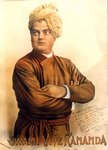
Swami Vivekananda Quotations

1. The only test of good things is that they make us strong.
- Swami Vivekananda

2. Is it not tremendously blasphemous to believe against reason? What right have we not to use the greatest gift that God has given to us? I am sure God will pardon a man who will use his reason and cannot believe, rather than a man who believes blindly instead of using the facilities He has given him.
- Swami Vivekananda

3. We are what our thoughts have made us; so take care about what you think. Words are secondary. Thoughts live; they travel far.
- Swami Vivekananda

4. The first sign of your becoming religious is that you are becoming cheerful.
- Swami Vivekananda

5. This I have seen in life, he who is overcautious about himself falls into dangers at every step; he who is afraid of losing honor and respect, gets only disgrace; he who is always afraid of loss always losses.
- Swami Vivekananda

6. In judging others we always judge them by our own ideals. That is not as it should be. Everyone must be judged according to his own ideal, and not by that of anyone else.
- Swami Vivekananda

Thursday, July 10, 2008

Strength Strength Strength.......

First, believe in the world—that there is meaning behind everything.

Don't look back—forward, infinite energy, infinite enthusiasm, infinite daring, and infinite patience—then alone can great deeds be accomplished.

This is the first lesson to learn: be determined not to curse anything outside, not to lay the blame upon anyone outside, but stand up, lay the blame on yourself. You will find that is always true. Get hold of yourself.

Tell the truth boldly, whether it hurts or not. Never pander to weakness. If truth is too much for intelligent people and sweeps them away, let them go; the sooner the better.

This life is a hard fact; work your way through it boldly, though it may be adamantine; no matter, the soul is stronger.

This I have seen in life—those who are overcautious about themselves fall into dangers at every step; those who are afraid of losing honor and respect, get only disgrace; and those who are always afraid of loss, always lose.

"Face the brutes." That is a lesson for all life—face the terrible, face it boldly. Like the monkeys, the hardships of life fall back when we cease to flee before them.
Those who work at a thing heart and soul not only achieve success in it but through their absorption in that they also realize the supreme truth—Brahman. Those who work at a thing with their whole heart receive help from God.

I, for one, thoroughly believe that no power in the universe can withhold from anyone anything they really deserve.

The whole secret of existence is to have no fear. Never fear what will become of you, depend on no one. Only the moment you reject all help are you free.

Fear is death, fear is sin, fear is hell, fear is unrighteousness, fear is wrong life. All the negative thoughts and ideas that are in the world have proceeded from this evil spirit of fear.
-Swami Vivekananda

Monday, June 30, 2008

Everybody Can Do Something

Roger Crawford had everything he needed to play tennis -- except two hands and a leg.
When Roger's parents saw their son for the first time, they saw a baby with a thumb- like projection extended directly out of his right forearm and a thumb and one finger stuck out of his left forearm. He had no palms. The baby's arms and legs were shortened, and he had only three toes on his shrunken right foot and a withered left leg, which would later be amputated.
The doctor said Roger suffered from ectrodactylism, a rare birth defect affecting only one out of 90,000 children born in the United States. The doctor said Roger would probably never walk or care for himself.
Fortunately Roger's parents didn't believe the doctor. My parents always taught me that I was only as handicapped as I wanted to be,รข€ said Roger. They never allowed me to feel sorry for myself or take advantage of people because of my handicap. Once I got into trouble because my school papers were continually late, explained Roger who had to hold his pencil with both hands to write slowly. I asked Dad to write a note to my teachers, asking for a two-day extension on my assignments.
Instead Dad made me start writing my paper two days early! Roger's father always encouraged him to get involved in sports, teaching Roger to catch and throw a volleyball, and play backyard football after school. At age 12, Roger managed to win a spot on the school football team.
Before every game, Roger would visualize his dream of scoring a touchdown. Then one day he got his chance. The ball landed in his arms and off he ran as fast as he could on his artificial leg toward the goal line, his coach and teammates cheering wildly. But at the ten-yard line, a guy from the other team caught up with Roger, grabbing his left ankle. Roger tried to pull his artificial leg free, but instead it ended up being pulled off.
I was still standing up, recalls Roger. I didn't know what else to do so I started hopping towards the goal line. The referee ran over and threw his hands into the air. Touchdown! You know, even better than the six points was the look on the face of the other kid who was holding my artificial leg. Roger's love of sports grew and so did his self-confidence.
But not every obstacle gave way to Roger's determination. Eating in the lunchroom with the other kids watching him fumble with his food proved very painful to Roger, as did his repeated failure in typing class. I learned a very good lesson from typing class, said Roger. You can't do everything - it's better to concentrate on what you can do. One thing Roger could do was swing a tennis racket. Unfortunately, when he swung it hard, his weak grip usually launched it into space. By luck, Roger stumbled upon an odd- looking tennis racket in a sports shop and accidentally wedged his finger between its double-barred handle when he picked it up. The snug fit made it possible for Roger to swing, serve and volley like an able-bodied player. He practiced every day and was soon playing - and losing - matches. But Roger persisted. He practiced and practiced and played and played. Surgery on the two fingers of his left hand enabled Roger to grip his special racket better, greatly improving his game. Although he had no role models to guide him, Roger became obsessed with tennis and in time he started to win. Roger went on to play college tennis, finishing his tennis career with 22 wins and 11 losses. He later became the first physically handicapped tennis player to be certified as a teaching professional by the United States Professional Tennis Association. Roger now tours the country, speaking to groups about what it takes to be a winner, no matter who you are.
The only difference between you and me is that you can see my handicap, but I can't see yours. We all have them. When people ask me how I've been able to overcome my physical handicaps, I tell them that I haven't overcome anything. I've simply learned what I can't do - such as play the piano or eat with chopsticks - but more importantly, I've learned what I can do. Then I do what I can with all my heart and soul.
-By Jack Canfield

Monday, June 16, 2008

Slow Poison....

A long time ago in China, a girl named Li-Li got married and went to live with her husband and mother-in-law. In a very short time, Li-Li found that she couldn't get along with her mother-in-law at all.
Their personalities were very different, and Li-Li was angered by many of her mother-in-law's habits. In addition, she criticized Li-Li constantly.

Days passed days, and weeks passed weeks. Li-Li and her mother-in-law never stopped arguing and fighting. But what made the situation even worse was that, according to ancient Chinese tradition, Li-Li had to bow to her mother-in-law and obey her every wish.

All the anger and unhappiness in the house was causing Li-Li's poor husband great distress.

Finally, Li-Li could not stand her mother-in-law's bad temper and dictatorship any longer, and she decided to do something about it.

Li-Li went to see her father's good friend, Mr. Huang, who sold herbs. She told him the situation and asked if he would give her some poison so that she could solve the problem once and for all. Mr. Huang thought for a while, and finally said, Li-Li, I will help you solve your problem, but you must listen to me and obey what I tell you. Li-Li said, "Yes, Mr. Huang, I will do whatever you tell me to do."

Mr. Huang went into the back room, and returned in a few minutes with a package of herbs.

He told Li-Li, "You can't use a quick acting poison to get rid of your mother-in-law, because that would cause people to become suspicious. Therefore, I have given you a number of herbs that will slowly build up poison in her body. Every other day prepare some delicious meal and put a little of these herbs in her serving. Now, in order to make sure that nobody suspects you when she dies, you must be very careful to act very friendly towards her. Don't argue with her, obey her every wish, and treat her like a queen."

Li-Li was so happy. She thanked Mr. Huang and hurried home to start her plot of murdering her mother-in-law.

Weeks went by, and months went by, and every other day, Li-Li served the specially treated food to her mother-in-law. She remembered what Mr. Huang had said about avoiding suspicion, so she controlled her temper, obeyed her mother-in-law, and treated her like her own mother. After six months had passed, the whole household had changed.

Li-Li had practiced controlling her temper so much that she found that she almost never got mad or upset. She hadn't had an argument with her mother-in-law in six months because she now seemed much kinder and easier to get along with.

The mother-in-law's attitude toward Li-Li changed, and she began to love Li-Li like her own daughter. She kept telling friends and relatives that Li-Li was the best daughter-in- law one could ever find. Li-Li and her mother-in-law were now treating each other like a real mother and daughter. Li-Li's husband was very happy to see what was happening.

One day, Li-Li came to see Mr. Huang and asked for his help again. She said, "Dear Mr. Huang, please help me to keep the poison from killing my mother-in-law! She's changed into such a nice woman, and I love her like my own mother. I do not want her to die because of the poison I gave her."

Mr. Huang smiled and nodded his head. "Li-Li, there's nothing to worry about. I never gave you any poison. The herbs I gave you were vitamins to improve her health. The only poison was in your mind and your attitude toward her, but that has been all washed away by the love which you gave to her."

Tuesday, June 3, 2008

Some Important Lessons Life Teaches US...

1- Most Important Lesson

During my second month of nursing school, our professor gave us a pop quiz. I was a conscientious student and had breezed through the questions, until I read the last one:

"What is the first name of the woman who cleans the school?"

Surely this was some kind of joke. I had seen the cleaning woman several times. She was tall, dark-haired and in her 50s, but how would I know her name? I handed in my paper, leaving the last question blank.
Just before class ended, one student asked if the last question would count toward our quiz grade. "Absolutely," said the professor. "In your careers, you will meet many people. All are significant. They deserve your attention and care, even if all you do is smile and say 'hello'."

"I've never forgotten that lesson. I also learned her name was Dorothy.

Second Important Lesson- Pickup in the Rain

One night, at 11:30 PM, an older African American woman was standing on the side of an Alabama highway trying to endure a lashing rain storm. Her car had broken down and she desperately needed a ride.

Soaking wet, she decided to flag down the next car. A young white man stopped to help her, generally unheard of in those conflict-filled 1960s. The man took her to safety, helped her get assistance and put her into a taxi cab. She seemed to be in a big hurry, but wrote down his address and thanked him. Seven days went by and a knock came on the man's door. To his surprise, a giant console color TV was delivered to his home. A special note was attached.
It read: "Thank you so much for assisting me on the highway the other night. The rain drenched not only my clothes, but also my spirits. Then you came along. Because of you, I was able to make it to my dying husband's bedside just before he passed away. God bless you for helping me and unselfishly serving others."
Sincerely, Mrs. Nat King Cole.

Third Important Lesson - Always remember those who serve you

In the days when an ice cream sundae cost much less, a 10 year old boy entered a hotel coffee shop and sat at a table. A waitress put a glass of water in front of him.
"How much is an ice cream sundae?" he asked.
"Fifty cents," replied the waitress. The little boy pulled his hand out of his pocket and studied the coins in it. "Well, how much is a plain dish of ice cream?" he inquired. By now more people were waiting for a table and the waitress was growing impatient.
"Thirty-five cents," she brusquely replied."
The little boy again counted his coins.
"I'll have the plain ice cream," he said.
The waitress brought the ice cream, put the bill on the table and walked away. The boy finished the ice cream, paid the cashier and left. When the waitress came back, she began to cry as she wiped down the table. There, placed neatly beside the empty dish, were two nickels and five pennies - You see, he couldn't have the sundae, because he wanted to have enough left to leave her a tip.

Fourth Important Lesson - The Obstacle in Our Path

In ancient times, a King had a boulder placed on a roadway. Then he hid himself and watched to see if anyone would remove the huge rock. Some of the king's wealthiest merchants and courtiers came by and simply walked around it.
Many loudly blamed the king for not keeping the roads clear, But none did anything about getting the stone out of the way.

Then a peasant came along carrying a load of vegetables. Upon approaching the boulder, the peasant laid down his burden and tried to move the stone to the side of the road.

After much pushing and straining, he finally succeeded. After the peasant picked up his load of vegetables, he noticed a purse lying in the road where the boulder had been.

The purse contained many gold coins and a note from the king indicating that the gold was for the person who removed the boulder from the roadway. The peasant learned what many of us never understand.

Every obstacle presents an opportunity to improve our condition.

Fifth Important Lesson - Giving When it Counts

Many years ago, when I worked as a volunteer at a hospital, I got to know a little girl named Liz who was suffering from a rare and serious disease.

Her only chance of recovery appeared to be a blood transfusion from her 5-year old brother, who had miraculously survived the same disease and had developed the antibodies needed to combat the illness. The doctor explained the situation to her little brother, and asked the little boy if he would be willing to give his blood to his sister.

I saw him hesitate for only a moment before taking a deep breath and saying, "Yes, I'll do it if it will save her.." As the transfusion progressed, he lay in bed next to his sister and smiled, as we all did, seeing the color returning to her cheeks. Then his face grew pale and his smile faded. He looked up at the doctor and asked with a trembling voice, "Will I start to die right away?"

Being young, the little boy had misunderstood the doctor; he thought he was going to have to give his sister all of his blood in order to save her.

You see, understanding and attitude, after all, is everything.

. . . . remember to:

"Work like you don't need the money. ~ Love like you've never been hurt, and ~ Dance like you do when nobody's watching."
* * * * * * * * * * * * * * * * *